How to Run an SEO Content Audit That Revives Your Declining Organic Traffic

If your organic traffic has taken a slow, painful nosedive, you don't need to panic—you need a systematic seo content audit.
Many marketing teams react to falling traffic by churning out more new blog posts. This is a mistake. More often than not, the culprit isn't a lack of new content, but rather the silent decay of your existing assets.
By systematically evaluating what you already have, you can uncover hidden keyword cannibalisation, fix broken search intent, and breathe new life into pages that once drove high-value conversions.
Here is a quick overview of what a modern, high-impact content audit entails:
Key Takeaways: Your Actionable SEO Content Audit Strategy
| Audit Phase | Core Action | Expected Outcome |
|---|---|---|
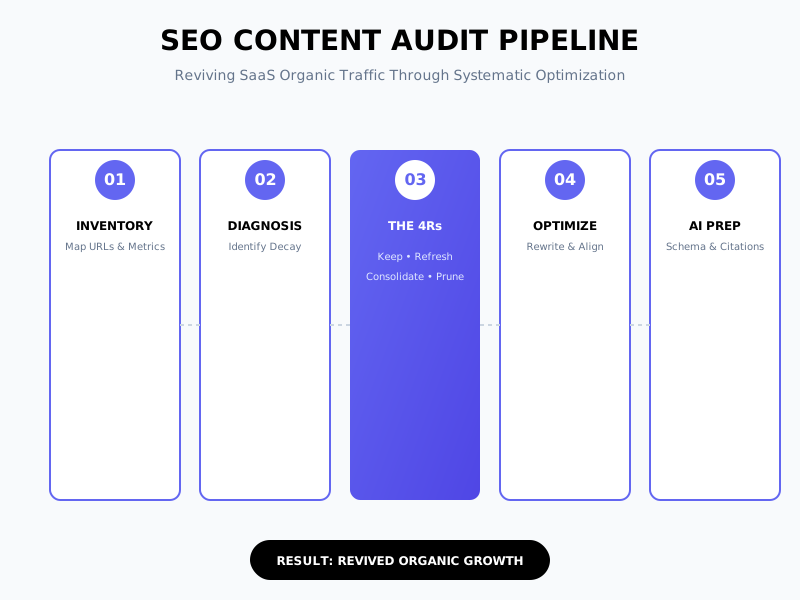
| 1. Inventory & Mapping | Compile all URLs, crawl data, and GA4/GSC metrics into a single source of truth. | Complete visibility over your site's current content footprint. |
| 2. Decay Diagnosis | Identify pages with declining traffic, keyword cannibalisation, or outdated data. | A clear list of high-priority pages requiring urgent attention. |
| 3. The 4R Classification | Categorise every URL into: Keep, Refresh, Consolidate, or Prune. | An actionable roadmap for your editorial and technical teams. |
| 4. Historical Optimisation | Rewrite thin content, update statistics, and align pages with current search intent. | Revived organic rankings and a significant boost in lead generation. |
| 5. AI Visibility Prep | Structure content with clear definitions and schema to secure citations in AI search engines. | Future-proofed visibility across ChatGPT, Perplexity, and Gemini. |
What Is an SEO Content Audit and Why Is It Essential for Declining Traffic?
An seo content audit is the process of systematically evaluating all the indexable content on your website to assess its performance, relevance, and structural health.
Unlike a purely technical SEO audit—which focuses on server response times, crawl budgets, and XML sitemaps—a content audit looks at the qualitative and quantitative value of your written assets. It helps you understand whether your pages are helping you rank, confusing search engines, or actively dragging down your site’s overall domain authority.
Identifying Content Decay Before It Tanks Your Rankings
Content decay is the gradual loss of organic traffic and keyword rankings over time. It is an inevitable part of the search lifecycle. Even your best-performing articles will eventually lose momentum if left untouched.
To combat this, you need an active content decay strategy. This strategy focuses on identifying pages that are sliding down the search engine results pages (SERPs) before the traffic drop becomes catastrophic.
[Peak Performance] ──> [Competitor Updates / Intent Shifts] ──> [Traffic Decay Begins] ──> [Urgent Refresh Required]
Decay typically happens for three reasons:
- Competitor updates: Competitors publish more comprehensive, up-to-date, or better-structured articles.
- Search intent shifts: Google changes its mind about what users actually want to find when they search for a specific query.
- Information obsolescence: Your article references outdated statistics, dead links, or obsolete product features.
According to research by Ahrefs' content decay guide, over 90% of web content receives zero organic traffic from Google. If you do not actively monitor and update your existing assets, they will inevitably slip into that quiet, traffic-less majority.
The Business Impact: Organic Reach vs. Paid Acquisition Costs in the European Market
For European SaaS and tech companies, relying solely on paid acquisition (like Google Ads or LinkedIn Campaign Manager) is becoming increasingly unsustainable. Customer Acquisition Costs (CAC) are rising across the continent, driven by fierce competition and tightening data privacy regulations.
Optimising your existing content is one of the most cost-effective ways to lower your blended CAC. Research from HubSpot demonstrates that updating historical blog posts can increase organic lead generation by over 100%.
Instead of spending thousands of Euros writing ten new articles from scratch—which can take months to index and rank—you can spend a fraction of that resource updating five legacy pieces that already have established backlink profiles and historical authority. The ROI of this approach is immediate and compounding.
How Do You Prepare for an SEO Content Audit? (The Audit Checklist)
Before you start editing or deleting pages, you need to lay the groundwork. Jumping in without a structured plan will lead to analysis paralysis or, worse, the accidental deletion of pages that are quietly driving conversions.

Gathering Your Content Inventory Across CMS Platforms and Subdomains
The first step in your SEO audit checklist is to build a comprehensive inventory of every URL on your site.
If you run a complex setup—such as a Webflow marketing site, a WordPress blog on a /blog subdirectory, and a custom documentation portal on a docs. subdomain—you need to crawl all of them. Use tools like Screaming Frog or Sitebulb to map out your site architecture and export a clean list of all indexable, HTML URLs.
Selecting Core Performance Metrics: Traffic, Conversions, and Search Intent Fit
Once you have your URLs, you need to overlay them with performance data from the past 12 months. Your primary data sources should include:
- Google Search Console (GSC): For impressions, clicks, average position, and CTR.
- Google Analytics 4 (GA4): For sessions, bounce rates, average engagement time, and direct conversions.
- SEO Tools (Ahrefs/Semrush): For backlink profiles, referring domains, and organic keyword counts.
GDPR-Compliant Data Gathering for European Site Analytics
If your business operates in Europe, you must ensure your data gathering process complies with GDPR. GA4 must be configured to anonymise IP addresses, and cookie consent banners must be fully functional before tracking scripts load.
If you are looking to simplify your stack or avoid the complexities of consent-heavy tracking, consider integrating privacy-first, EU-hosted analytics tools like Matomo or Plausible alongside GSC to track basic traffic trends.
Automated Content Evaluation vs. Manual Spreadsheet Review
Traditionally, running an audit meant exporting massive CSV files, merging them in Excel using complex VLOOKUP formulas, and manually reviewing thousands of rows. This manual approach is slow, prone to human error, and often out of date by the time the spreadsheet is finished.
A study by Gartner indicates that adopting automated content evaluation cuts audit cycle times by up to 70% compared to manual tracking. Automated pipelines continuously fetch GSC and GA4 data, flag pages showing signs of decay, and highlight keyword cannibalisation issues automatically.
This is why modern B2B marketing teams are shifting their workflows. A study by the Content Marketing Institute revealed that 65% of leading B2B marketers actively prune and update legacy content quarterly. Doing this manually every three months is impossible; automation is the only way to maintain organic velocity at scale.
For a deeper dive into how automated workflows stack up against traditional setups, you can read our comparison of Search Engine Optimization Cost UK: Agency vs In-House vs AI | SiteLift.
What Step-by-Step Strategy Reverses Content Decay?
Once your data is gathered, it is time to diagnose why your traffic is slipping and execute a historical content optimization plan.
Diagnosing the Root Causes of Declining Organic Traffic
Do not assume a drop in traffic means the article is simply "old." You must diagnose the root cause:
- Keyword Cannibalisation: Do you have three different blog posts targeting the exact same keyword? If so, Google may be struggling to decide which page to rank, causing all of them to bounce around the second page of the SERPs.
- Outdated Search Intent: Did the SERP shift from informational guides to transactional product pages? If searchers now want a tool instead of a 3,000-word guide, your article will continue to drop regardless of how well it is written.
- Competitor Feature Creep: Check the top three ranking pages for your target keyword. Have they added interactive calculators, custom infographics, or downloadable templates that your page lacks?
The 4R Decision Matrix: Keep, Refresh, Consolidate, or Prune
To make your audit actionable, run every URL through the 4R Decision Matrix. This categorisation framework ensures that every page on your site has a clear, logical next step.
| Decision | Criteria | Action Plan |
|---|---|---|
| Keep | High traffic, high conversions, stable rankings. | Leave it alone. Monitor monthly to ensure performance remains steady. |
| Refresh | Declining traffic, high backlink authority, outdated stats, or minor intent mismatch. | Update data, rewrite intro/outro, add new media, and optimise on-page SEO. |
| Consolidate | Multiple thin pages targeting the same keyword (cannibalisation). | Merge the best elements into one master guide. Redirect old URLs to the new one. |
| Prune | Zero traffic, zero backlinks, irrelevant to your current product offering or audience. | Delete the page and return a 410 (Gone) or 301 redirect to a relevant category page. |
A Historical Content Optimization Framework for Maximum ROI
When you identify an article that needs a refresh, do not just make cosmetic changes. Follow this structured framework to maximise your search performance:
- Step 1: Check Google's Helpful Content Guidelines. Ensure your content aligns with official Google Search Central guidelines by focusing on human-first, original analysis. Add real-world examples, unique expert quotes, and proprietary data.
- Step 2: Update the Search Intent. If the top results now feature step-by-step videos, embed a video. If they feature checklists, add an interactive checklist.
- Step 3: Fix Broken Links and Media. Replace dead external links with fresh, high-quality resources. Update old screenshots that show outdated software interfaces.
- Step 4: Improve Internal Linking. Link from your newly refreshed page to your high-value transactional pages, and find newer blog posts to link back to your refreshed asset.
- Step 5: Request Reindexing. Once updated, submit the URL in Google Search Console to nudge Google’s spiders to recrawl the page immediately.
Pro Tip: When refreshing content, keep the original URL structure exactly the same if possible. Changing the URL slug resets its social share counts and can disrupt existing backlink equity, even with a 301 redirect in place.
Redirection and Canonicalisation Best Practices
When consolidating thin or duplicate articles, handling your redirects correctly is vital for preserving link equity:
- 301 Redirects: Use a permanent 301 redirect when you are merging Page A into Page B. This tells search engines that the content has permanently moved, passing roughly 90-99% of the ranking power to the new page.
- Canonical Tags: If you must keep two highly similar pages live for user experience reasons (such as regional variations or event-specific landing pages), use a
rel="canonical"tag pointing to the primary version to prevent duplicate content penalties.
For a comprehensive guide on identifying these content gaps and structural overlaps, take a look at our guide on Content Gap Analysis SEO: Steal Competitor Traffic Fast | SiteLift.
How Can AI and Automation Streamline Content Audits and AI Engine Visibility?
The way people search is undergoing a fundamental shift. While traditional search engines like Google still drive the majority of organic traffic, AI-powered conversational search engines are rapidly gaining ground.
Your content strategy must adapt to keep pace with both.
Leveraging Continuous Content Decay Monitoring Systems
The biggest flaw in traditional content auditing is that it is a retrospective, point-in-time exercise. You run an audit, clean up your site, and then ignore it for another twelve months while decay quietly sets in again.
Modern teams are replacing this cycle with continuous monitoring. By connecting your CMS directly to automated evaluation tools, you can establish automated alerts that trigger the moment a page's organic visibility drops below a specific threshold. This turns your content maintenance from a reactive project into an active, automated pipeline.
Preparing Audited Content for Generative Engine Optimisation (GEO)
As searchers increasingly turn to platforms like ChatGPT, Gemini, and Perplexity for quick answers, your seo content audit must look beyond traditional organic rankings. You need to optimise your content for Generative Engine Optimisation (GEO).
To ensure your audited content is cited as a source by AI engines, you should:
- Provide Clear, Direct Definitions: Use simple, jargon-free language to define concepts early in your articles. AI models love concise, direct definitions that they can easily extract for user queries.
- Use Structured Data (Schema Markup): Implement robust schema markup (such as Article, FAQ, or Product schema) to make it easy for LLMs to parse and understand your page's entities and context.
- Include Authoritative, First-Party Data: AI engines are trained to look for consensus and credible sources. Including original statistics, proprietary research, and quotes from verified industry experts makes your content highly quotable.
This is where automated visibility platforms like sitelift.io come into play. Instead of manually auditing, rewriting, and re-optimising your content catalog, SiteLift acts as an autonomous growth engine.
It continuously monitors your site's search footprint, identifies content decay, and automatically generates, updates, and distributes high-quality content across a premium network. This keeps your brand highly visible across both traditional search engines and emerging AI platforms without requiring constant manual intervention.
My Hot Take: Why Traditional Content Audits are a Waste of Time
I’ve spent the better part of a decade working in search marketing, and I’m going to say something that might ruffle a few feathers: traditional content audits are a colossal waste of time.
We’ve all been there. You spend three weeks export-matching GA4 data, screaming at Screaming Frog, and building a 10,000-row Excel sheet colour-coded in pastel green and red. You present it to the leadership team, everyone nods sagely, and then... nothing happens. The spreadsheet sits in a shared Google Drive folder, gathering digital dust, while your organic traffic continues its slow, agonizing slide.
[Traditional Audit] ──> [Massive Excel Sheet] ──> [Analysis Paralysis] ──> [No Action Taken]
The problem is that manual audits are too slow, too overwhelming, and outdated the moment you hit "Export."
By the time you finish categorising your 500th blog post, Google has run another core algorithm update, three competitors have refreshed their top guides, and your search intent assumptions have shifted. You’re trying to navigate a fast-moving, dynamic landscape using a static map from last month.
If you want to survive the dual challenges of content decay and AI search, you have to abandon the "once-a-year spreadsheet" mentality. You need to treat content health as a continuous, automated software loop.
Stop auditing your site manually. Automate the tracking, build real-time decay dashboards, and focus your human creativity on what AI can't replicate: original insights, proprietary data, and genuine, opinionated expert voices.
— Mark van der Heijden, SEO Architect & Tech Strategist
Ready to Dominate Search and AI Engines on Autopilot?
Running a manual seo content audit and constantly battling content decay can feel like a full-time job. Between gathering data, rewriting old posts, and trying to optimise for new AI search engines, your marketing team can easily run out of steam.
SiteLift solves this by automating your entire SEO and AI visibility growth pipeline.
Our autonomous platform monitors your rankings in real-time, automatically identifies content decay, and publishes highly targeted, expertly written content designed to rank on both Google and conversational AI engines.
- Autonomous Optimization: Keep your content library fresh and relevant without lifting a finger.
- Multi-Platform Visibility: Ensure your brand is cited across ChatGPT, Perplexity, Google, and Gemini.
- Seamless CMS Integration: Works out-of-the-box with your existing web infrastructure.
Don't let legacy content drag your business down. Let SiteLift compound your organic authority on autopilot.
Discover SiteLift Today and reclaim your search momentum.
FAQ
How often should European SaaS companies run an SEO content audit?
European SaaS companies should run a comprehensive content audit at least once every quarter. Because software markets move quickly, competitor updates and product feature changes can cause rapid content decay. Quarterly audits ensure you catch declining traffic and keyword cannibalisation issues before they impact your pipeline.
What is the difference between a technical SEO audit and a content SEO audit?
A technical SEO audit focuses on your website's underlying infrastructure—evaluating crawlability, indexation, page speed, mobile friendliness, and schema markup. A content SEO audit, on the other hand, focuses on the quality, relevance, and performance of your written copy, assessing metrics like search intent fit, keyword cannibalisation, and content decay.
How do you identify content decay using Google Search Console and GA4?
To identify content decay, look for pages in Google Search Console that have experienced a steady decline in impressions and clicks over a 3 to 6-month period, even if their average position hasn't dropped significantly yet. Cross-reference this in GA4 to see if organic sessions and average engagement times on those specific URLs are also slipping.
Should you delete or redirect underperforming blog posts during an audit?
It depends on the page's history and authority. If an underperforming post has high-quality backlinks, do not delete it; instead, redirect it (301) to a relevant, high-performing page or consolidate it with another article. If the post has zero backlinks, zero traffic, and holds no value for your target audience, you can safely delete it and return a 410 (Gone) status code.
How does historical content optimization help improve search engine rankings?
Historical content optimization works by leveraging the existing authority and backlink profile of an older page. By updating outdated statistics, aligning the content with current search intent, and improving readability, you signal to Google that the page is fresh and highly helpful. This often results in a rapid jump in rankings that is much faster than publishing a brand-new article.
Article generated by SiteLift
Topics Covered:
- seo content audit
- content decay strategy
- historical content optimization
- SEO audit checklist
- automated content evaluation
More from SiteLift

AI for SEO: How to Automate Research, Content Creation and Distribution
Learn how to use AI for SEO to automate keyword research, generative content creation, CMS publishing, and search engine visibility.

SEO Tools in 2026: How to Build an Autonomous Stack That Grows Traffic on Autopilot
Discover how to build an autonomous stack with modern AI SEO tools, automated publishing workflows, and real-time rank tracking to grow organic traffic.

Repurposing Content for SEO: How to Multiply Organic Reach Across Channels
Learn how repurposing content for SEO multiplies organic reach. Discover step-by-step strategies for syndication, AI visibility, and automation.